
Your needs, this model
Does it fit your priorities?
Does the Tiny 3 Lite combine 4K with 60 fps?
No. OBSBOT lists the Tiny 3 Lite at 4K through 30 fps, with 1080p as a separate mode reaching 120 fps. It can meet a 4K or a 1080p60 requirement, but the documented maxima do not establish 4K60. Check that the intended application offers the specific mode you need.
Explore this need in the finder →Is the Tiny 3 Lite fixed focus or autofocus?
The Tiny 3 Lite table lists autofocus with PDAF and manual focus. Its listed minimum focus distance is 10 cm, compared with 14 cm for the separate Tiny 3 model; that is a specification, not a close-up focus test. Use another reviewed model if fixed focus is a requirement.
Explore this need in the finder →Does pointing the lens down guarantee that the Tiny 3 Lite microphone is off?
The English Tiny 3 Lite manual says pointing the lens straight down enters Sleep Mode. OBSBOT's Tiny 3 Series FAQ says the microphone state during Sleep Mode can be configured in OBSBOT Center, so lens-down sleep is not proof that camera audio is muted. If a live-call microphone mute is essential, verify the software state or use a separate mute route.
Explore this need in the finder →What is included in the Tiny 3 Lite base [Pack]?
The official store lists the Tiny 3 Lite camera, USB-C-to-C cable and USB-C-to-USB-A adapter. The base listing does not include the Tiny Smart Remote 2 or Vox SE microphone; the Remote Combo adds the remote, Standard Combo adds the remote and Vox SE, and Streaming Combo lists additional HDMI/tripod accessories. The built-in camera microphones are separate from those optional accessories.
Explore this need in the finder →What host, cable and app checks matter for a 4K workflow?
The manual says to use the standard data cable and connect directly to the computer, or use an independently powered dock if needed. It lists a supplied USB-C-to-A adapter and requires compatible third-party software for 4K streaming. The technical table does not state USB generation. OBSBOT recommends an M1-or-later Apple computer or a 10th-generation Intel Core i5-or-later PC with 8 GB RAM for 4K and 1080p120; confirm the actual host and software rather than reading that recommendation as a guarantee.
Explore this need in the finder →This is an assessment of model-specific manufacturer documentation, not a hands-on review. No image, tracking, microphone or compatibility tests are claimed.
A distinct camera, not a Tiny 3 bundle
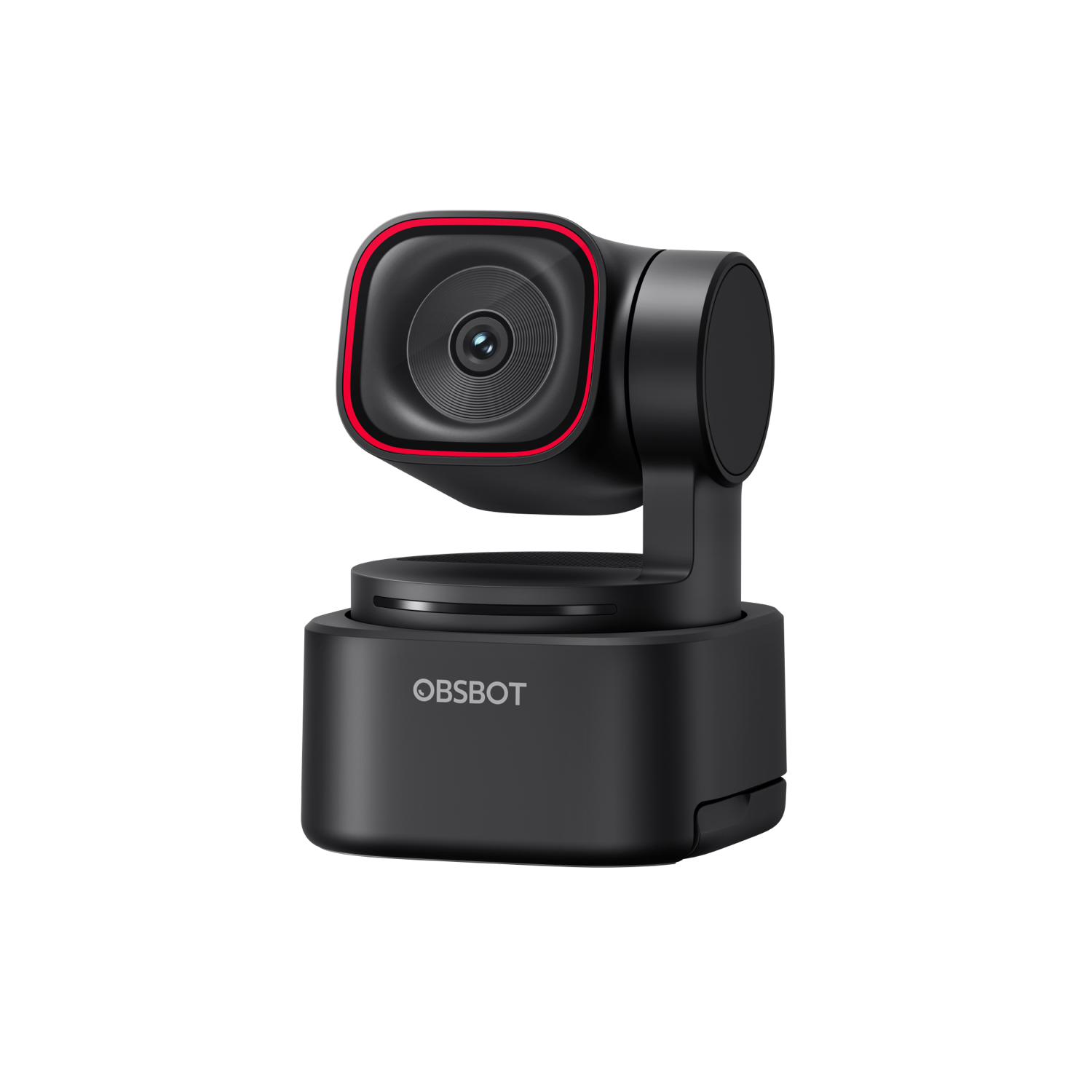
The OBSBOT Tiny 3 Lite is a separate motorized webcam model rather than a package variation of the Tiny 3. The manufacturer lists a 1/2-inch, 48-megapixel sensor in a 41 × 41 × 58 mm, 73 g body with an integrated stand. Tiny 3 has a different 1/1.28-inch, 50-megapixel sensor, a shorter published body and a separate adjustable mount. Those figures establish different hardware and package geometry, not a measured difference in picture quality. The Lite's base [Pack] lists the camera, a USB-C-to-C cable and a USB-C-to-USB-A adapter; it does not list Tiny 3's storage case or adjustable mount.
The built-in stand can rest on a monitor or desk, and the manual identifies a standard UNC 1/4-20 socket for a separate tripod. That is useful if the camera moves between a laptop screen and a desk, but check the monitor edge, stand clearance and cable bend against your own setup. The exact product image shows the integrated stand, not the full package.
Read resolution and frame rate as separate modes
OBSBOT's technical table lists 4K at up to 30 frames per second and a separate 1080p mode up to 120 fps. A 1080p60 filter is met by a listed Full HD mode, but those separate maxima do not make a 4K60 camera. The table associates the higher-resolution combinations with MJPEG; YUV appears only at 640 × 480 and 640 × 360. If you need high-resolution YUV, H.264, or 4K60 specifically, the reviewed Tiny 3 Lite documentation does not establish those modes.
The manual also says 4K streaming requires compatible third-party software. For 4K or 1080p120, OBSBOT recommends Apple computers with an M1 chip or later, or a PC with a 10th-generation Intel Core i5 or later and 8 GB of RAM. Those are setup recommendations, not a promise that each video-call program or host will expose the desired mode. Test the intended application and host requirements before buying for a production workflow.
USB-C does not identify the data rate
The manual identifies a USB-C camera port and the base package provides a C-to-C cable and C-to-A adapter. It advises using the standard cable and connecting directly to the computer, or to a dock with independent power if the host supply is insufficient. The Lite specification table lists 5 V / 0.5 A power, but the reviewed Tiny 3 Lite sources do not state the USB generation. Do not infer a USB 3 data path from the connector shape, the cable's C connectors or a 4K label.
OBSBOT lists Windows 10 64-bit or later and macOS 11 or later for the software. Before choosing this model for a managed computer, check application policy, the actual port and any external dock; the manual's high-mode recommendations are not compatibility certification.
Autofocus, framing and a compact two-axis head
The Lite specification lists autofocus with phase detection as well as manual focus in OBSBOT Center, a 10 cm minimum focus distance, 4× digital zoom and a two-axis gimbal with a documented pan-and-tilt range. The manual describes human tracking and voice or gesture control. These capabilities can matter when the speaker wants framing to change without moving the monitor-mounted base. They do not guarantee tracking accuracy, quick focus, or a good close-up of a particular desk object; the 4× figure is digital cropping, not optical reach.
The published view is 79.1 degrees diagonal in 4:3 or 72 degrees in 16:9, with 66.9 degrees horizontal. Use those fixed lens figures as a starting point for positioning, then account for the intended crop and camera-to-person distance. A wider room view and digital zoom can trade places; the mode table alone does not establish how a chosen application applies crop or framing. Tiny 3's Desk and Whiteboard modes are not Lite package additions—the maker distinguishes those modes from the Lite's supported landscape, portrait, downward and upside-down mounting orientations.
Built-in audio and the sleep-state caveat
OBSBOT lists one omnidirectional and two directional microphone elements, plus five selectable audio modes. That makes camera-side audio a documented feature rather than something that depends on the optional Vox SE. It is not a listening test, so mic count and named modes should not be read as evidence of pickup quality in a noisy room. The manufacturer lists Vox SE in separate bundles, and the selected package should be checked if you expect an external wireless mic.
The manual says pointing the lens straight down enters Sleep Mode, creating a physical lens-cover position. One important qualification comes from the series FAQ: the microphone state while the camera is in Sleep Mode can be configured in OBSBOT Center. A lens-down position therefore does not guarantee a muted microphone. If a live-call mute is essential, verify the setting or use a separate, dependable audio mute rather than assuming that the lens position controls sound.
Package names change the included equipment
The official U.S.-facing store separates the Tiny 3 Lite [Pack] from a Remote Combo, Standard Combo and Streaming Combo. The Remote Combo adds Tiny Smart Remote 2; the Standard Combo lists the remote and a Vox SE Wireless Microphone; the Streaming Combo adds the remote, a UVC-to-HDMI Adapter 2nd Gen, Vox SE, an extendable tripod and mini ball head. Those are bundle contents, not additional Tiny 3 Lite camera versions. The base [Pack] list does not include the remote, external microphone, HDMI adapter or tripod.
The page does not publish a manufacturer part number, and the dynamic product_id in its store route is not a SKU. The local raw page request also redirected to a France/French view, which is preserved as a locale-specific capture; the English U.S.-facing product information was reviewed separately. Verify the exact package, camera, cable/adapter, accessory count and seller terms for the offer you intend to buy. No price, current stock or exact ASIN is asserted here.
Where the documentation leaves a decision
On documented features, the Tiny 3 Lite is a compact choice to compare when a buyer wants a motorized camera, autofocus, built-in microphones and either 4K30 or higher-rate Full HD from an integrated stand. Its limits matter just as much: there is no documented 4K60 mode, high-resolution YUV, or USB generation; 4K streaming needs compatible software; and Sleep Mode's microphone state is configurable rather than guaranteed off. The different Lite sensor and integrated stand also make it a different package from Tiny 3, not a cheaper bundle with identical details.
Before settling on an offer, confirm the model selector says Tiny 3 Lite, check which named bundle is supplied, match the host and application to the actual mode, and verify how sleep-time audio is configured. This source-based assessment cannot predict image quality, autofocus success, audio clarity, temperature or tracking behavior in your particular room.
Key specifications
Key details at a glance
| Documented modes and host limits | 4K is listed through 30 fps and 1080p is separately listed through 120 fps. The maximums are not combined as a 4K60 mode. |
|---|---|
| Focus system | Autofocus |
| Built-in microphone | Yes |
| Physical privacy shutter | Yes |
Use the exact model’s instructions for operating limits, supplied equipment and version differences.
Sources for this review
Sources for this assessment
- OBSBOT U.S. Store webcam-card snapshot
- OBSBOT Tiny 3 Lite U.S.-store model and package page
- OBSBOT Tiny 3 Series model page
- OBSBOT Tiny 3 Series technical specifications
- OBSBOT Tiny 3 Lite User Manual EN v1.0
- OBSBOT Tiny 3 Series FAQ
- OBSBOT Tiny 3 Series downloads page
- OBSBOT official product comparison
- OBSBOT Tiny 3 Series launch announcement
- Official OBSBOT Tiny 3 Lite product image

Compare the features that affect your setup
Set essential video, focus, privacy and microphone requirements together; leave nonessential choices open.